Myriad Cloud 218% Throughput Performance Boost
The Plan
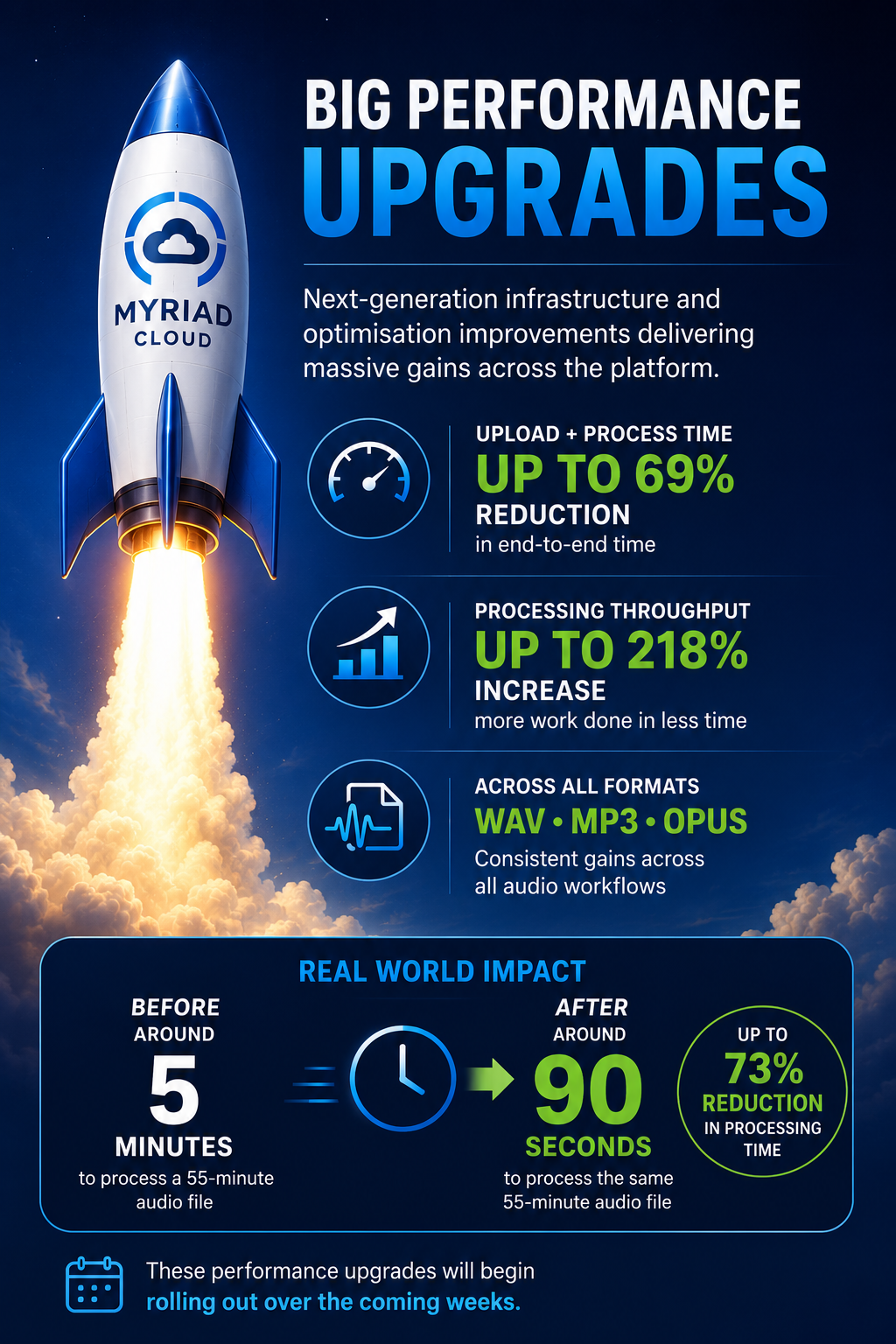
The Broadcast Radio Myriad Cloud team have recently completed work on a wide ranging project to boost performance across the Myriad Cloud platform, and the results are quite impressive.
The performance boost project focused on two approaches to increasing performance:
- Upgrading underlying infrastructure.
- Software performance optimisations in audio ingest and processing.
The upgrades to the underlying cloud infrastructure are designed to increase performance across the board for all aspects on Myriad Cloud.
For the software optimisation, we focused specifically on the audio ingest, transcoding and processing as a recent customer survey identified these as potential bottlenecks in regular workflows.
The infrastructure upgrade is well underway with customers being seamlessly migrated to the new platform over the past few weeks. This process is on track to be completed by the end of May for all customers, who can expect immediate performance benefits once their station has moved across.
The software optimisations are included in the v6.9 release which recently entered beta testing on Myriad Cloud.
Once v6.9 goes full release, Myriad Cloud customers can upgrade by simply clicking the Update Now button in the Myriad Control Panel. Simply visit the portal, choose Settings > Myriad Cloud > Control Panel, then click on the top banner.
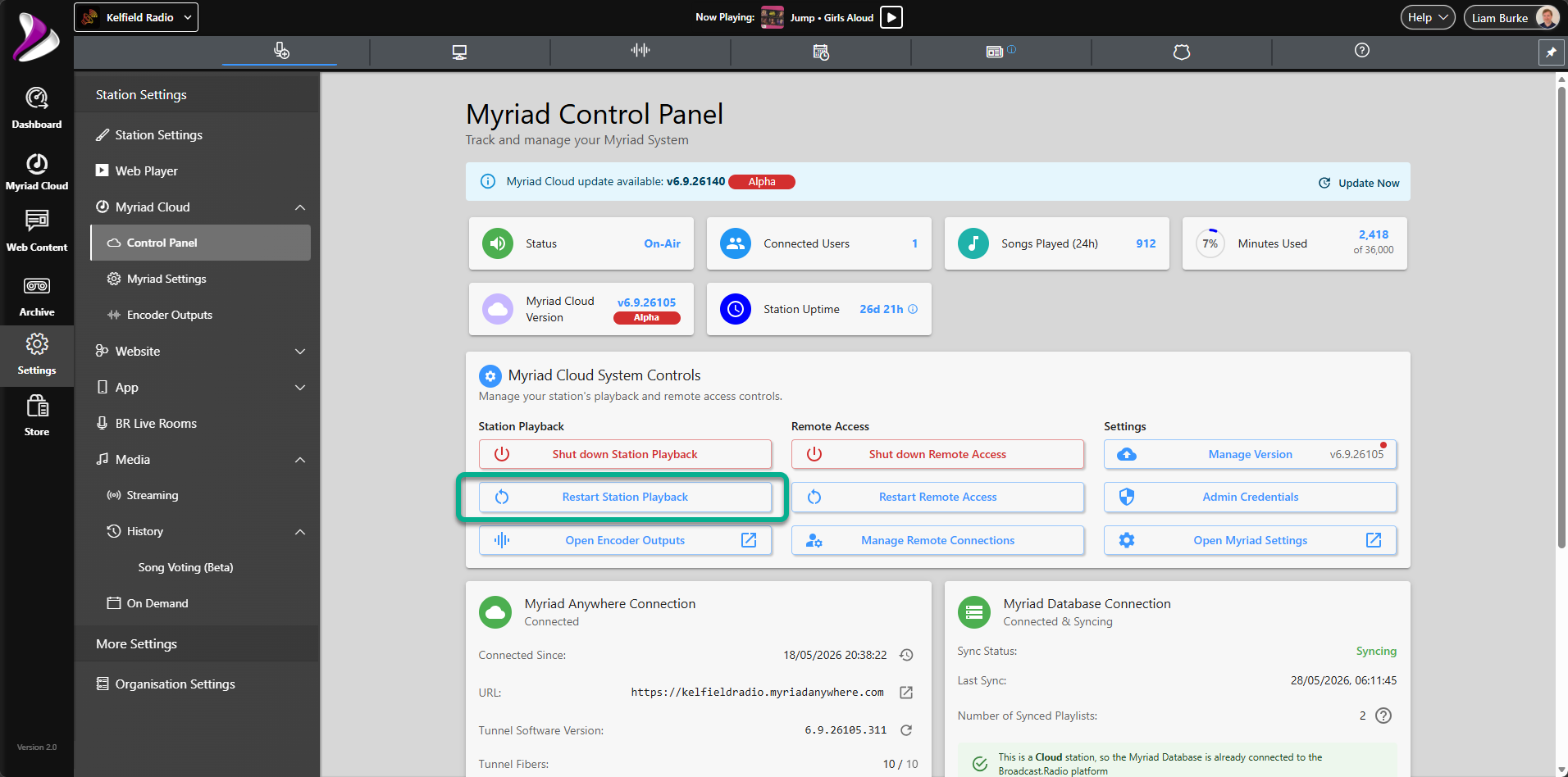
The full release of v6.9 will also be announced in the notification bar on the Control Panel window.

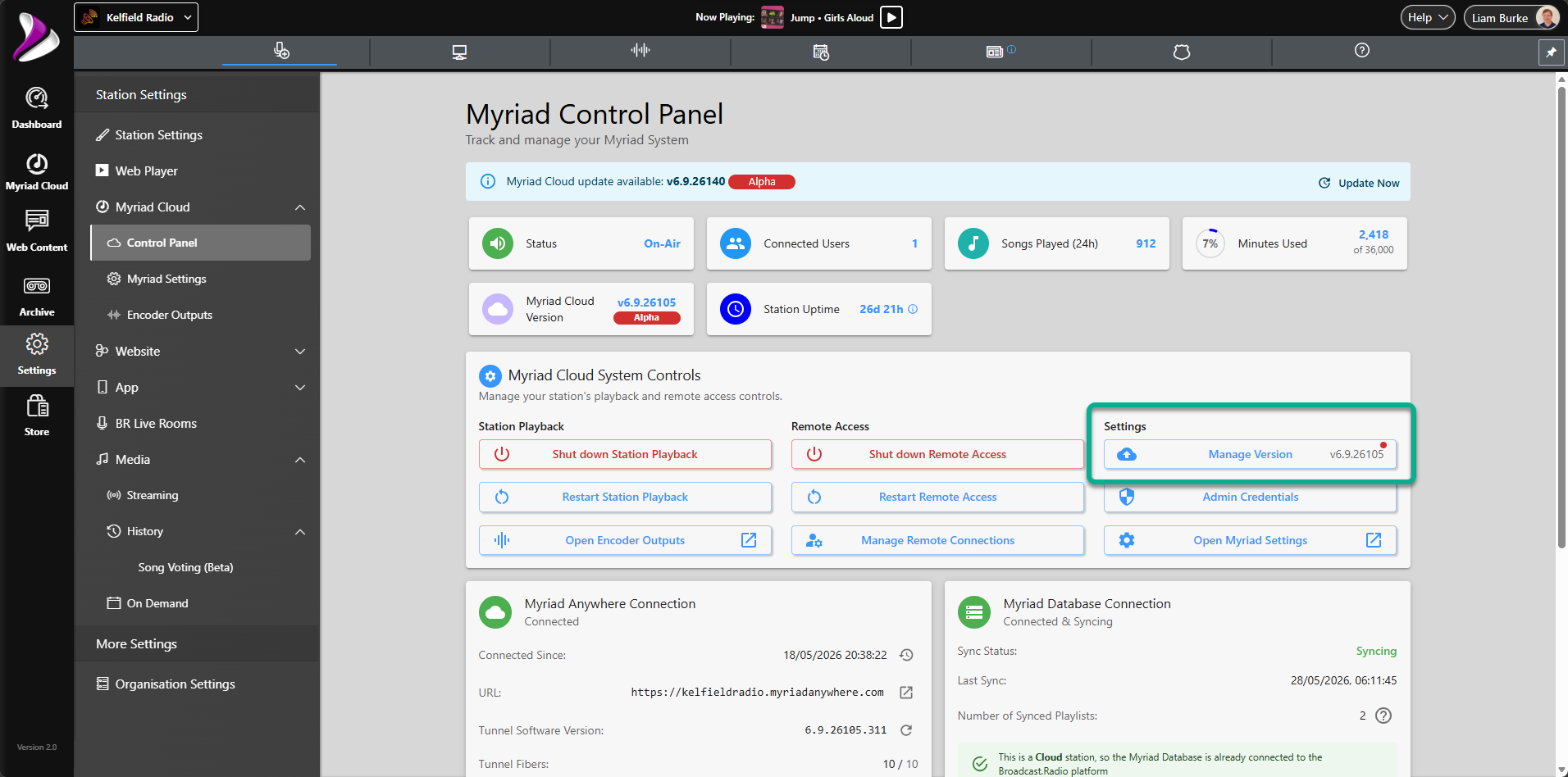
If you can't wait to experience the significant performance gains included in v6.9, you can opt into the beta version via - Settings > Myriad Cloud > Control Panel > Manage Version.
This setting window allows you to select whether your Station is on the Alpha, Beta or Full Release track or to set a specific release version to use.
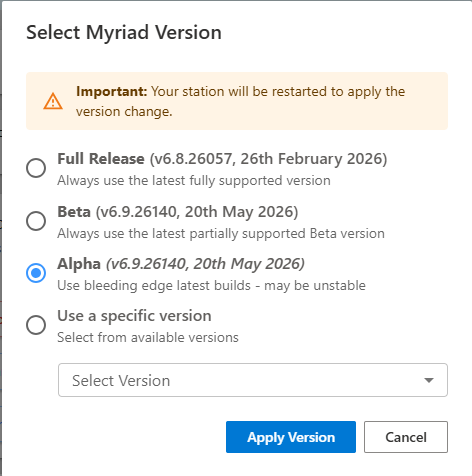
Please note that changing this option will result in your Station restarting with the selected version.
The Results
Audio Processing Performance Test Summary
Overview
A series of benchmark tests were carried out using a 55-minute audio file in WAV, MP3 and OPUS formats to measure upload and processing performance under three different environments:
- Current production platform (control)
- New host nodes with uprated CPUs and newer generation processors
- New host nodes + new Alpha software containing a range of optimisation improvements
Each test was repeated multiple times to ensure consistent and representative results.
Key Findings: Significant Processing Time Reductions Across All Formats
The combination of the new infrastructure and Alpha optimisation work delivered substantial improvements across every audio format tested.
End-to-End Upload + Processing Improvements
Compared to the current production platform:
- WAV processing time reduced from 5.24 mins to 1.70 mins~68% reduction in processing time
- ~214% increase in throughput performance
- MP3 processing time reduced from 5.05 mins to 1.59 mins~69% reduction in processing time
- ~218% increase in throughput performance
- OPUS processing time reduced from 3.24 mins to 1.16 mins~64% reduction in processing time
- ~179% increase in throughput performance
Processing-Only Improvements
When isolating processing performance alone:
- WAV processing time reduced by ~61%
- MP3 processing time reduced by ~61%
- OPUS processing time reduced by ~64%
Equivalent throughput increases were observed across all formats as a result of the reduced processing durations
.
Infrastructure Improvements Alone Also Delivered Major Gains
Even before applying the software optimisations, the upgraded host hardware delivered significant improvements.
New Host Nodes Only
Compared to the current production environment:
- WAV processing times reduced by ~41%
- MP3 processing times reduced by ~42%
- OPUS processing times reduced by ~63%
This demonstrates that both the upgraded infrastructure and the software optimisation work contribute meaningfully to the overall platform improvements.
Overall Conclusion
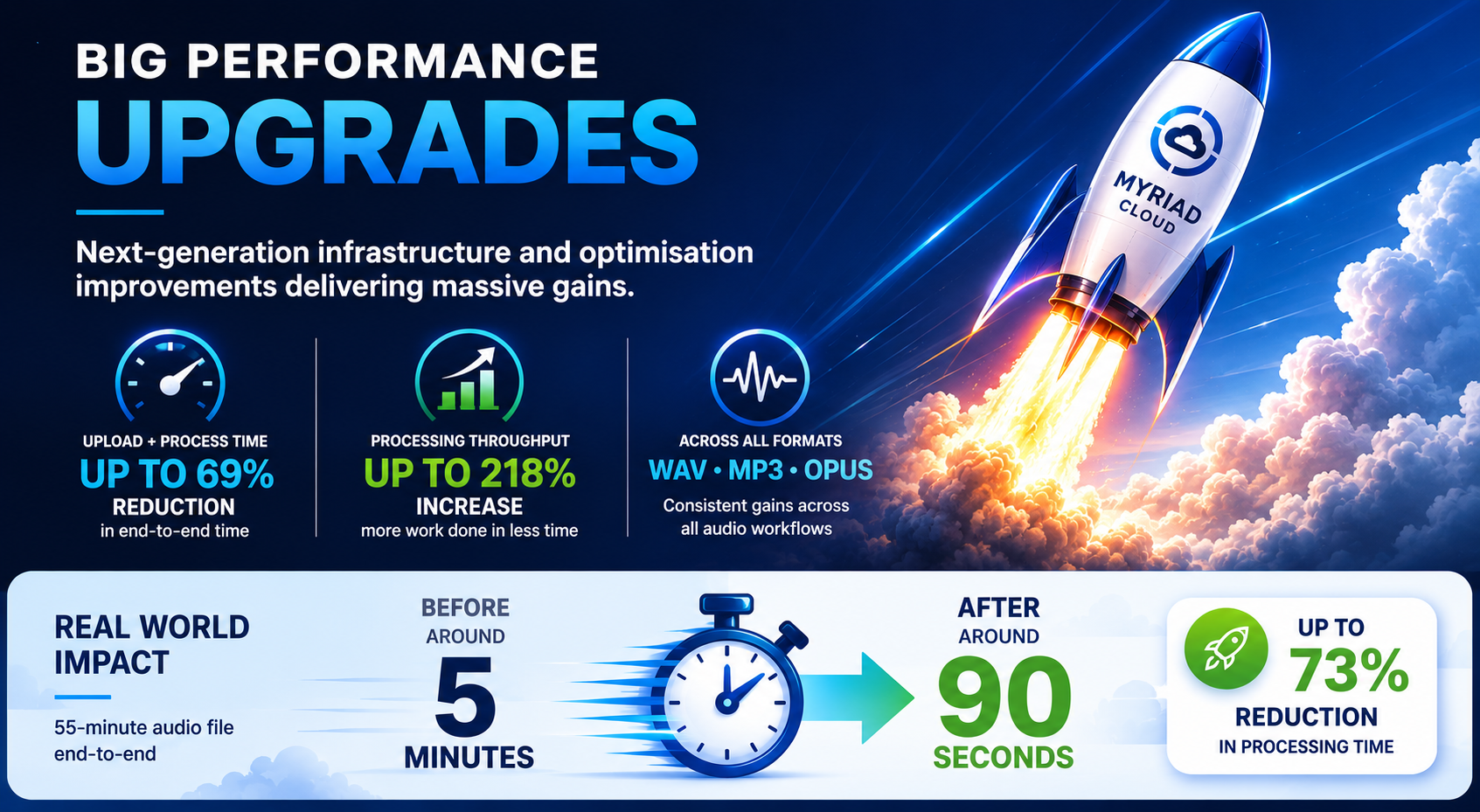
The testing clearly shows that the upcoming platform upgrades will dramatically reduce audio upload and processing times across the board.
The combination of:
- newer generation processors
- increased CPU capacity
- container host improvements
- ongoing optimisation work in the software platform
results in consistently faster processing for all tested formats.
In real-world terms, audio workflows that previously took around five minutes to process are now completing in closer to ninety seconds — representing both major reductions in waiting time and substantial increases in processing throughput.
These improvements will help deliver:
- faster content turnaround
- reduced waiting times
- improved responsiveness
- greater scalability under load
- a smoother experience across the platform
Rollout of these improvements will continue over the coming weeks.